
Aluminum Landing Craft
Aluminum landing craft boats for sale, built to order in Anacortes, Washington: our models, what landing craft do and how to choose one.
- 20′–50′+
- Monohull or catamaran
- 16° or 20° bottom
- Outboard, sterndrive or waterjet
- Double-seal bow door
- Self-bailing decks
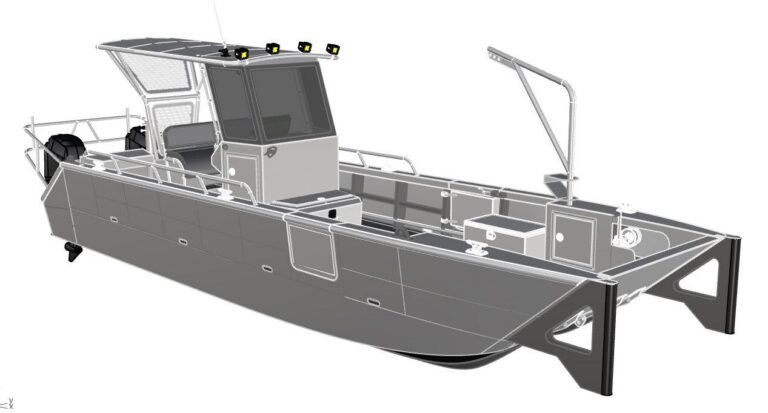
An aluminum landing craft is a work boat with a bow door, a front ramp that lowers onto the beach, so people, freight and small vehicles go straight on and off where there's no dock. Nothing gets heaved over the side or squeezed through a side door.
ARMOR designs and builds aluminum landing craft from 20′ to 50′+ in two forms: a monohull that carries the most for its length and takes any power, and a catamaran that sits steadier and beaches on both hulls. Each one is built to your length, bottom, power and layout. Our models and built examples come first below, then a guide to what landing craft are used for, how to choose between the types and options, and what to look for in how one is built.
Our landing craft
No multi-year waiting list. We take on fewer boats at a time, so yours starts sooner.
| Example | Type | Length × beam | Power | Layout | Status |
|---|---|---|---|---|---|
| Landing Craft 21 Dive | Monohull | 21′ × 8′-6″ | 200+ hp outboard | Open dive | Built |
| Landing Craft 23 | Monohull | 23′ × 8′-6″ | 200+ hp outboard | Center console, hardtop | Built |
| Landing Craft 24 T-top | Monohull | 24′ × 8′-6″ | Single ~200 hp outboard | Center console T-top | Designed |
| Jet Landing Craft 24 / 28 | Monohull | 24′ or 28′ × 8′-6″ | Diesel + waterjet | Walkaround half cabin | Designed |
| Catamaran Landing Craft 28′-6″ | Catamaran | 28′-6″ × 8′-6″ | Twin outboards, 150+ hp each | Center console | Built |
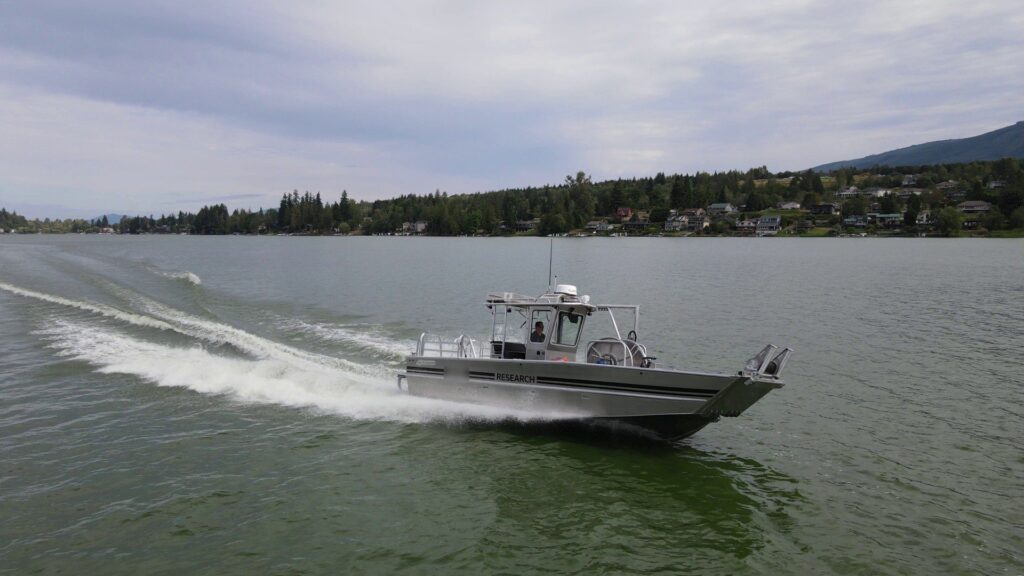
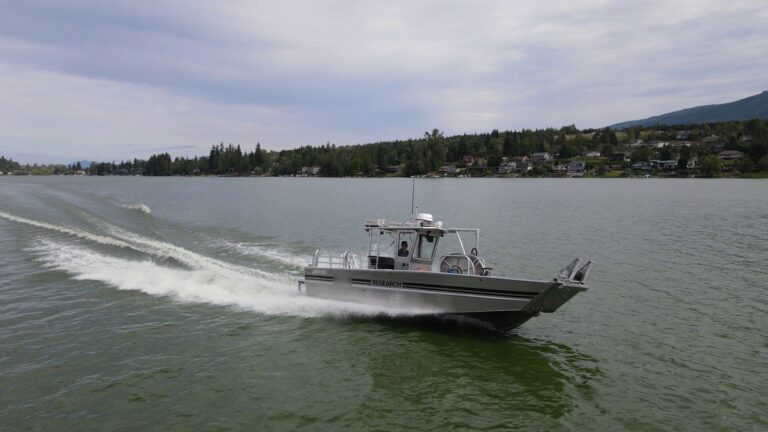
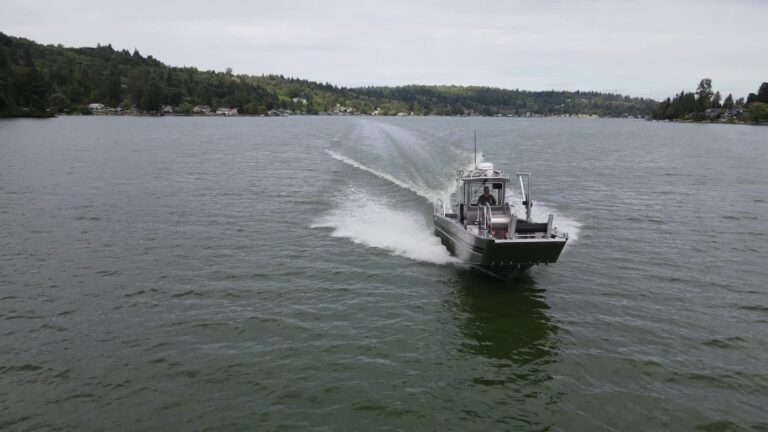
| Landing Craft 30 research and net boat | Monohull | 29′-6″ × 8′-6″ | Diesel sterndrive | Center console T-top | Built 2025 |
| Landing Craft 32 | Monohull | 32′ × 10′–10′-6″ | Twin 200–400 hp outboards | Cabin, two ways: the earlier design with a front gantry and boom, or the newer styling | Designed |
Small landing craft, 20′ to 24′, keep an 8′-6″ beam and can go on a trailer. Larger ones grow in beam and plate with length.
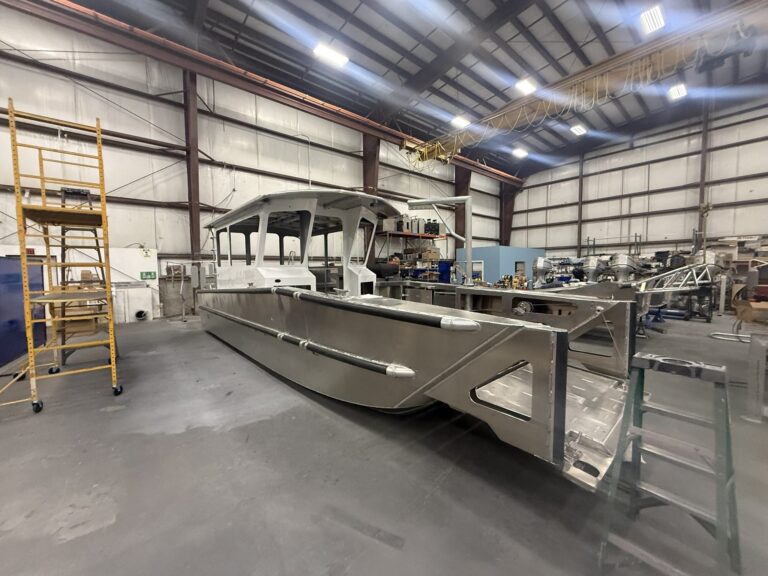
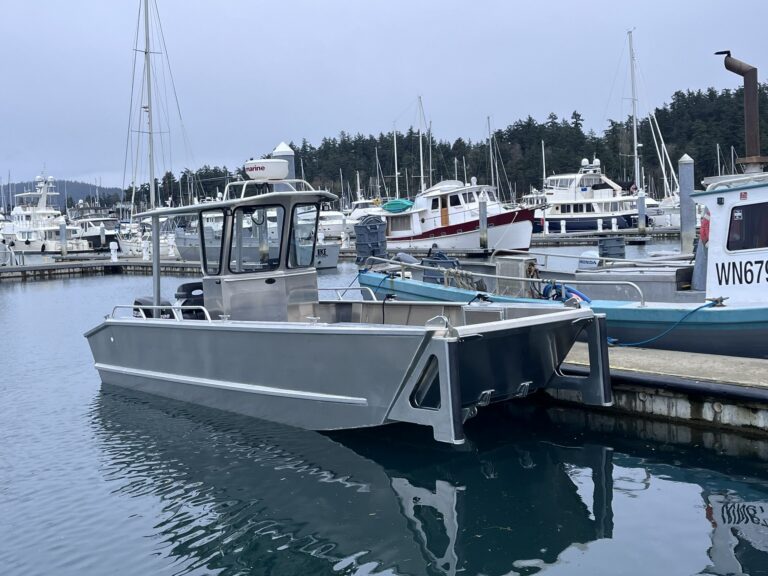
What is a landing craft?
Landing craft are boats built to move cargo, equipment, vehicles and people across the water and put them straight onto a shoreline. The bow door is what makes one a landing craft: it lowers to form a ramp between the deck and the beach.
Landing craft first went to work in large numbers in World War II. Today most do commercial, research and government work, and many belong to people who need to reach an island, a cabin or a beach with no dock. Compared with a regular workboat of the same length, a landing craft trades some sleekness for a wide, open deck, a square bow and a hull made to run up onto a beach and back off again, loaded.
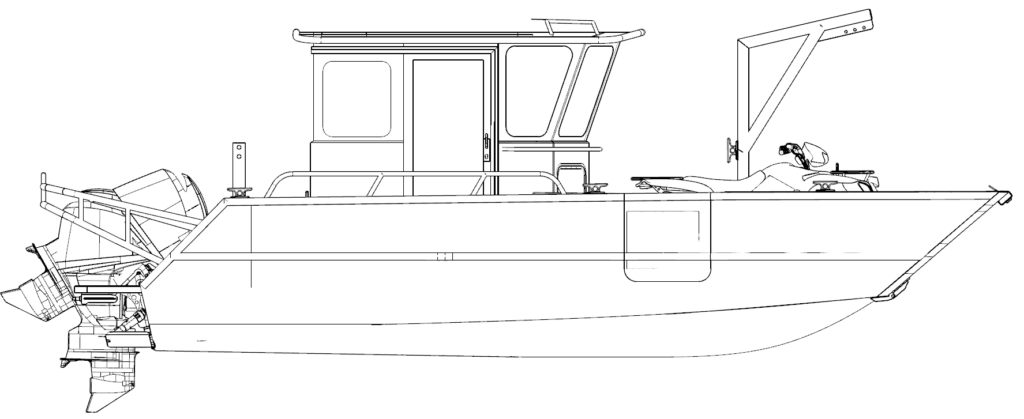
What landing craft are used for
Island and shoreline supply
Freight, building materials, fuel and groceries to places without a dock.
Construction and utilities
Crews, tools and materials for shoreline, dock and utility work, run by power, gas and oil companies and their contractors.
Research and survey
Sampling gear, davits and winches for universities and research teams.
Diving
A wide, open deck with dive doors and tank racks, so divers get off and back aboard easily.
Fisheries
Net drums, line haulers and totes. Our Landing Craft 30 was built as a research and net boat, with a net drum on its work deck.
Spill response
Boom, gear and crews put onto the shoreline where the work is.
Emergency response
Rescue crews and equipment landed where there's no dock.
Recreation and property access
ATVs, motorcycles and camping gear to remote beaches, islands and cabins.
Monohull or catamaran?
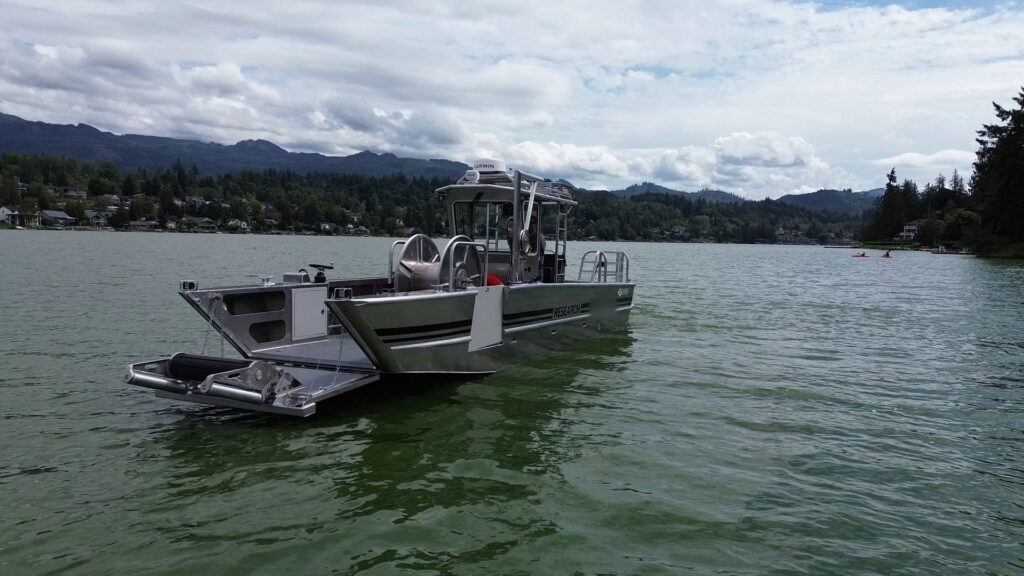
Both are built the same way: CNC-cut 5086 plate, welded self-bailing decks and a double-seal bow door. The difference is one hull or two, and it changes what the boat is best at.
| Monohull landing craft | Catamaran landing craft | |
|---|---|---|
| Best for | Carrying the most weight for its length, and any power | Stability at rest and gentle, level beaching |
| Payload | More for its length | Less for its length, and more sensitive to how it's loaded |
| Beaching | Comes up on its keel and beaching plates | Both hulls touch the beach together |
| Bottom | 16° shallow-water or 20° rough-water | Two hulls |
| Power | Single or twin outboards, diesel sterndrive or diesel waterjet | Twin outboards |
| Lengths | 20′–50′+ | 20′–50′+ |
| Layouts | Open or dive, center console T-top, side console, walkaround half cabin, full cabin | Open deck, center console, aft console T-top, full cabin |
| Bow door | Double seal; 65″ on a 24′ to 78″ on a 32′ | Double seal; sized to the beam (67″ on the 28′-6″) |
| Built examples | Landing Craft 21 Dive, 23 and 30 research and net boat | 28′-6″ center console; full-cabin dive and research boat in build |
Choose the catamaran when stability at rest and gentle beaching matter more than maximum payload. Choose the monohull to carry the most weight for its length, or for diesel sterndrive or waterjet power.
16° or 20°: choosing a bottom
Deadrise is the angle of the bottom at the transom. On a landing craft it sets how the boat rides, how much it carries and how shallow it runs.
16° shallow-water bottom
Runs shallower and carries more for its size. Right for rivers, sloughs, tide flats and sheltered bays.
20° rough-water bottom
Rides better in a chop. Right for open straits, sounds and coastal runs.
Not sure?
Tell us your route and your load, and we'll recommend one. It's one of the first questions we work through with every owner.
Power: outboard, sterndrive or waterjet
Outboards
The simplest choice: easy to service and replace, and they tilt up for beaching. Single or twin on the monohull; twin on the catamaran.
Diesel sterndrive
Diesel range and economy, with a drive that tilts for beaching. It can also run hydraulics for net drums, davits and winches through a power takeoff. Our Landing Craft 30 research and net boat runs one.
Diesel waterjet
Nothing below the hull, so it runs the shallowest water and beaches with no lower unit to protect. Our Jet Landing Craft 24 and 28 are designed around a diesel and a waterjet.
Layouts and options
Layouts
- Open deck or dive layout
- Center console with T-top
- Side console
- Aft console with T-top (catamaran)
- Walkaround half cabin
- Full cabin with head, heat and air conditioning
Options
- Dive doors, ladders and tank racks
- Davits, capstans and windlass
- Hydraulic net drum and line hauler
- Electric bow winch with a mechanical backup (standard)
- Fire pump (it can be mounted out of sight)
- Shore power and generator
- T-top, hardtop or bimini
- Chartplotter, radar and VHF
- Trailer
What to look for in an aluminum landing craft
Landing craft take more abuse than most boats: they're beached, loaded at the bow and worked hard. These are the things worth checking on any landing craft, and how we build ours.
| Check | Why it matters | How ARMOR builds it |
|---|---|---|
| Bow door and seal | The door takes every load and every wave at the bow. A weak seal lets water in. | Double seal on every door; electric winch with a mechanical backup; opening sized to the job, 65″ on a 24′ to 78″ on a 32′ |
| Bottom plate | Beaching grinds the bottom, every trip. | 1/4″ 5086 bottom up to 35′; 5/16″ from 36′ |
| Keel and beaching plates | The keel meets the beach first. | Standing centerline vertical keel, 3/8″–1/2″, with 1/4″ beaching plates |
| Side plate | Docks, pilings and other boats. | 3/16″ sides up to 35′ (1/4″ optional); 1/4″ from 36′ |
| Deck | Water comes over the bow and the sides; it has to drain on its own. | 3/16″ welded decks, always self-bailing |
| Weight at the bow | A landing craft loads at the bow. A hull balanced like a normal boat trims down by the bow when loaded. | Hydrostatics optimized for bow loading, with the centers of flotation and buoyancy moved forward |
| Compartments | Watertight bulkheads limit flooding if the hull is ever holed. | Watertight bulkheads and half-pipe hull stiffeners |
| Design and build | A builder that designs in-house can change the boat for your job. | In-house 3D CAD; CNC-cut, plate-marked parts; welded to AWS D1.2 and D3.7 |
The ARMOR standard
- Every part modeled in 3D CAD and reviewed with you before plate is cut
- CNC-cut parts, plate-marked with forming and welding instructions, so every hull matches the drawing
- Formed on a 12′, 200-ton CNC press brake
- Welded to written procedures, to AWS D1.2 and AWS D3.7
- Marine-grade 5086 and 5052 aluminum throughout
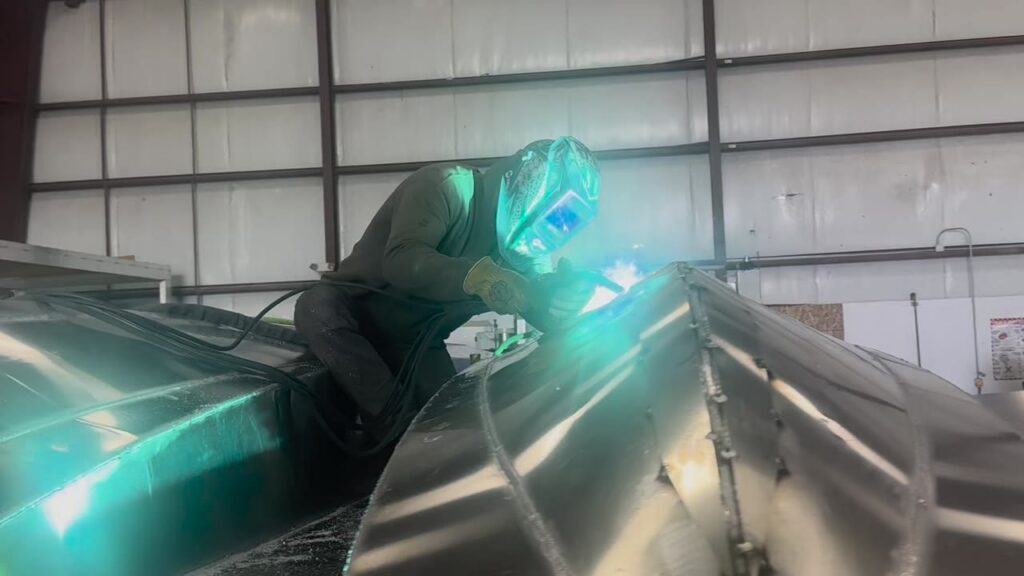
Built in our 16,000 sq ft Anacortes facility, with a full-length 5-ton bridge crane and room for vessels up to 100′. Because every part is drawn in 3D CAD and CNC-cut, we're set up for multi-boat and fleet contracts as well as one-off custom builds.
Warranty: 10-year limited hull warranty for commercial use; lifetime limited hull warranty for recreational use.
How landing craft payload works
A landing craft's payload is set by its displacement: how much water the hull can push aside at a safe loaded waterline, less the boat's own weight, fuel and crew. Length and beam set that, so a 25′ landing craft can't haul a 15,000 lb excavator: that takes a boat of about 40′ or more.
| Length | Typical beam | Estimated payload |
|---|---|---|
| 20′–24′ | 8′-6″ | About 2,000–4,000 lb |
| 25′–29′ | 8′-6″–9′ | About 3,000–6,000 lb |
| 30′–34′ | 10′–11′ | About 5,000–9,000 lb |
| 35′–40′ | 12′–14′ | About 9,000–16,000 lb |
| 41′–50′+ | 14′–16′+ | Inquire |
These are rough estimates for planning, not ratings: a monohull with a typical power package, fuel and crew aboard. Real payload depends on where the load sits, how the boat is configured and outfitted, and how much fuel, crew and gear are aboard. A catamaran carries less for its length, about 2,000–4,000 lb on our 28′-6″. Tell us the load and how you'll carry it, and we'll run the numbers for your boat.
Need something else?
Call us with your needs or ask about a custom proposal: we build landing craft around almost any requirement, within reason.
Built your wayEvery size, layout and power package on this page is a starting point. Length, beam, layout, power and outfitting can all change, and we work it out with you in 3D CAD before any plate is cut.
Start your custom buildLanding craft questions
Do you have landing craft for sale?
Yes: our aluminum landing craft for sale are built to order. Each one is built for its owner, from 20′ to 50′+, to their length, bottom, power and layout. Tell us about the job and we'll quote it.
What is a landing craft?
A boat with a bow door that lowers onto the beach as a ramp, so people, freight and small vehicles go straight on and off without a dock.
What are landing craft used for?
Island and shoreline supply, construction and utility work, research and survey, diving, fisheries, spill and emergency response, and getting ATVs and gear to remote beaches and cabins.
Monohull or catamaran: which should I choose?
Choose the catamaran for stability at rest and gentle beaching. Choose the monohull to carry the most weight for its length, or for diesel sterndrive or waterjet power.
16° or 20° bottom: which do I need?
16° runs shallower and carries more for its size. 20° rides better in rough water. We'll help you choose for your route.
Outboard, sterndrive or waterjet?
Outboards keep it simple. A diesel sterndrive can run hydraulics through a power takeoff. A diesel waterjet runs the shallowest water with nothing below the hull.
Can a landing craft carry an ATV or a small vehicle?
Yes. ATVs and motorcycles go on and off over the bow door; our 28′-6″ catamaran carries ATVs, gear and crew through its 67″ door. Tell us what you need to carry and we'll size the deck and door around it.
Do you build small landing craft?
Yes. Our smallest run 20′ to 24′ with an 8′-6″ beam: the 21′ dive boat, the 23′ and the 24′ T-top. They can go on a trailer.
How wide is the bow door?
It's sized to the boat and the job: from 65″ on a 24′ to 78″ on a 32′ monohull, and on the catamaran it's sized to the beam: 67″ on the 28′-6″. Every door has a double seal.
Are the decks self-bailing?
Always. Every ARMOR landing craft, monohull or catamaran, has welded, self-bailing decks.
Can I get a landing craft with a cabin?
Yes: a walkaround half cabin or a full cabin with a head, heat and air conditioning on the monohull, and a full cabin on the catamaran.
Can you build several matching landing craft for a fleet?
Yes. Every part is CNC-cut from the same 3D model, so the tenth hull matches the first, and our 16,000 sq ft shop is set up for multi-boat and fleet contracts.
Start your landing craft
We design every boat in-house, so we can build to your exact requirements and help you solve the technical problems a catalog boat can't.
Prefer to talk it through?