

Rigid Hull Inflatable Boats (RHIB)
Proven de Villiers RHIB designs, built in welded aluminum in Anacortes, Washington.
- 22′–39′
- Console, pilothouse or hardtop
- Outboard or waterjet
- Up to 48 kn (55 mph) as designed
- Built in the USA
- Exclusive US builder
A rigid hull inflatable boat, or RHIB, pairs a solid hull with an inflatable tube collar. It's the boat of choice for military boarding teams, coast guards, police units and rescue crews around the world: fast, stable, forgiving alongside other boats, and able to carry a full crew in rough water.
ARMOR Marine builds RHIBs designed by David de Villiers of De Villiers Marine Design in New Zealand, a designer with more than 30 years of RHIBs, workboats and patrol boats behind him. We're his exclusive US builder: his proven hulls, built to order in welded aluminum in our Anacortes shop.
What is a RHIB?
RHIB stands for rigid hull inflatable boat. A RHIB, also called a RIB (rigid inflatable boat), is a boat with a solid hull, usually aluminum or fiberglass, and an inflatable tube around its sides. The hull carries the load and gives a deep-V ride; the tube adds buoyancy and stability and a soft edge for coming alongside.
RHIBs grew out of fully inflatable boats. Replacing the fabric floor with a rigid hull made them faster, tougher and able to carry much more, and they spread quickly through navies, coast guards, police units and rescue services. Ours have welded aluminum hulls, built from the same marine-grade plate as every other ARMOR boat.
- 1Tube, also called the collar: reserve buoyancy, stability and a soft edge alongside
- 2Air chambers: baffles split the tube, so one puncture doesn't empty it
- 3Rubbing strake: a tough strip that takes the wear when the boat comes alongside
- 4Console with the helm and electronics
- 5Arch or T-top: lights, antennas, radar and shade
- 6Rigid hull, aluminum or fiberglass, with spray rails
- 7Keel: the backbone of the bottom
- 8Transom, carrying the engines
- 9Outboards or a waterjet
- 10Tube attachment: the tube is held to the hull along the sheer
- 11Self-draining deck, above the waterline
- 12Deep-V bottom, for a soft ride at speed in a chop
- 13Deadrise: the angle of the V
Does a RHIB need its tube to float?
No. The rigid hull floats on its own. The tube is reserve buoyancy: it adds stability when the boat is loaded or heeled, and buoyancy if water comes aboard. It also takes the bumps of low-speed contact alongside.
Tubes are tough, but they can be cut, punctured or worn by the sun, which is why they're divided into several air chambers. Keeping a tube at the right pressure and replacing it when it's worn is part of owning a RHIB.
Round tube or D-collar?
On a classic RHIB the hull and the tube are designed together. The hull is a narrow deep V, and a round tube sits on top of its sides, so the tube makes up a big part of the boat's beam. It rides close to the water: it touches down as the boat stops or heels, which steadies it, and it cushions the boat alongside.
A D-collar boat starts from a hard-sided hull with its sides carried up to a gunwale. The flat back of the D mounts against those sides, so the deck runs out to the hull side and you get back about half the tube's width as deck inside the same beam. The collar sits a little higher and comes into play as the boat loads up or heels.
A round tube on a narrow hull is the lightest, softest-riding way to build a RHIB, and it's what military crews usually choose. A D-collar boat carries more deck and gear for its size and rides more on its hull, which is why it's popular for patrol and boarding. A D-collar can be air-filled, foam-filled, or solid foam with a polyurea coating.
Cross-sections, not to scale, drawn to the same overall beam. Dashed line: waterline at rest. Drawings: ARMOR Marine.
Bottom area and displacement. Beam is usually set by the trailer, the slip or the davits, so what counts is how much of it is running surface. A round tube uses beam the bottom can't have, a D-collar gives some back, and the ARMOR hull collar gives the most, because the bottom runs out under the collar. More bottom carries the same weight at a shallower draft, gets the boat on plane at a lower speed and takes more load before it squats, which suits jet drives. The foam collar adds reserve buoyancy above the waterline, out at the sides where it does the most good, as the boat is loaded or heels. The trade-off is ride: a wider, flatter bottom rides harder in a steep chop than a narrow deep V, so we set the deadrise for the water you run.
Air, foam or the ARMOR hull collar?
What fills the collar matters as much as its shape. Here's how the options compare.
| Air-filled tube or D-collar | Foam-filled D-collar | Polyurea-coated foam collar | ARMOR hull collar | |
|---|---|---|---|---|
| What it is | A polyurethane tube, split into air chambers | A closed-cell foam core inside a tough skin | Solid closed-cell foam shaped to the hull and coated in polyurea | The welded aluminum hull, shaped to form the collar and filled with closed-cell foam |
| If it's cut or punctured | That chamber goes soft; the others hold | It keeps its buoyancy | It keeps its buoyancy; the coating can be repaired | Nothing to puncture: the foam sits inside aluminum |
| Weight | Lightest | Heavier than air | Heavier than air | Part of the hull structure |
| Coming alongside | Softest | Firmer than air | Firm and tough | Firm: it's aluminum |
| Upkeep | Keep it at pressure; check the valves and seams | No pressure to keep; inspect the skin | Nothing to inflate; inspect the coating | Nothing to inflate or replace |
| Repairs | Patch a chamber, or replace the tube when it's worn | Repair the skin or replace a section | Repair the coating | Inboard panels come off for access |
| Best for | Boarding, rescue, ship's boats and the lightest boat | Patrol and work where a soft tube would stop the job | Patrol and rescue boats that take hard contact (Vigilance) | Law-enforcement patrol, with ballistic panels as an option |
We build and fit all of them: round polyurethane tubes, inflatable and foam-filled D-collars, and foam collars: the ARMOR hull collar on the Sentinels and a solid foam collar coated in polyurea on the Vigilance. Tell us how you'll use the boat and we'll recommend one.
Who uses RHIBs
Boarding teams
Fast, stable boats for coming alongside and putting a team aboard another vessel.
Police and marine patrol
Patrol, enforcement and security on coastal water and big lakes.
Search and rescue
Getting to people in the water fast and bringing them aboard over a low, soft side.
Ship's boats
Tenders and boarding boats launched from larger ships.
Offshore and commercial work
Crew transfer, survey and support for offshore projects.
Dive and research
Open decks and low sides for divers and scientists.
Training
Boat-handling and boarding training for crews.
Recreation
A fast, stable boat that's hard to beat in a chop.
Military RHIBs
RHIBs have been a military standard for decades: fast, seaworthy for their size and forgiving alongside another vessel. Here's what military crews use them for, and what they specify.
Boarding and interdiction
The speed to catch a vessel and a stable, soft-sided platform to put a boarding team aboard it.
Special operations
Fast insertion and recovery. Some designs fold their radar arch down so the boat fits inside a transport aircraft.
Ship's boats
Launched and recovered by davit or crane from a larger ship, sized to fit its cradle, with lifting points built in.
What crews specify
Shock-mitigating seats, tough multi-chamber tubes, tow and lifting points, and electronics to the unit's standard.
Our RHIB designs

22′ Center Console RHIB
21′-8″ × 8′-6″ on twin outboards, about 45 kn (52 mph) as designed. Trailerable console RHIB for patrol and boarding.

25′ Twin Outboard RHIB
24′-11″ × 9′-6″ on twin outboards up to 400 hp, about 46 kn (53 mph) as designed, 21° deadrise.

32′ Forward Console Police RHIB
32′ × 9′-9″ on twin 300 hp outboards, 45+ knots as designed, shock seats for 11 crew.

34′ Aft Console RHIB
34′-2″ × 10′-10″ on triple 300 hp outboards, 48 kn (55 mph) as designed, 12 passengers.
| Design | Length × beam | Power (as designed) | Speed (as designed) | Group |
|---|---|---|---|---|
| 22′ Center Console RHIB | 21′-8″ × 8′-6″ | Twin 140 hp outboards | About 45 kn (52 mph) | Console |
| 24′ River Jet RHIB | 24′ × 9′-6″ | Gas V8 inboard + HamiltonJet HJ241 | About 40 kn (46 mph) | Console |
| 24′ Special Ops RHIB (ship's boat) | 23′-9″ | Diesel sterndrive | Contact us | Console |
| 25′ Twin Outboard RHIB | 24′-11″ × 9′-6″ | Twin outboards to 400 hp total | About 46 kn (53 mph) | Console |
| 32′ Forward Console Police RHIB | 32′ × 9′-9″ | Twin 300 hp outboards | 45+ kn (52+ mph) | Console |
| 34′ Aft Console RHIB | 34′-2″ × 10′-10″ | Triple 300 hp outboards | 48 kn (55 mph) | Console |
| 31′ Pilothouse RHIB | 31′-2″ × 10′-9″ | Twin 250 hp outboards | 45 kn (52 mph) | Pilothouse |
| 32′ Pilothouse RHIB | 32′ × 12′-1″ | Twin 350 hp outboards | 48 kn (55 mph) | Pilothouse |
| 33′ Pilothouse RHIB | 32′-9″ × 12′ | Twin 350 hp outboards | 47 kn (54 mph) | Pilothouse |
| 39′ Fast Response RHIB | 39′-7″ × 11′-3″ | Three 250–350 hp outboards | 38–46 kn | Pilothouse |
| 37′ Twin Jet Fast Response RHIB | 36′-7″ × 12′-10″ | Twin Yanmar 6LY440 + HamiltonJet HJX27 | 38–40 kn | Quick response |
| 25′ QRV RHIB, waterjet | 24′-9″ × 8′-6″ | Diesel + HamiltonJet HJ241 | 41 kn (47 mph) | Quick response |
| 26′ QRV RHIB, outboard | 25′-3″ × 9′-11″ | Twin 150 hp outboards | 40 kn (46 mph) | Quick response |
| 30′ QRV RHIB, waterjet | 29′-10″ × 9′-5″ | Diesel + HamiltonJet | 40 kn (46 mph) | Quick response |
| 32′ QRV RHIB | 31′-8″ × 10′-3″ | Twin 250 hp outboards | 45 kn (52 mph) | Quick response |
| 36′ QRV RHIB | 35′-8″ × 12′-8″ | Twin diesels + waterjets | 35 kn (40 mph) | Quick response |
| 39′ QRV RHIB | 38′-5″ × 14′ | Twin diesels + HamiltonJet | 40 kn (46 mph) | Quick response |
Designed by David de Villiers. Built in the USA by ARMOR Marine, the exclusive US builder of de Villiers designs. Speeds and power are as designed; every boat is built to order, and we'll set up the power and outfit for your mission.
Console, pilothouse or quick response?
Console RHIBs
Open, fast and light: boarding, patrol and special operations. 22′ to 34′, on outboards or a waterjet.
Pilothouse RHIBs
An enclosed helm for offshore patrol and long shifts in the weather. 31′ to 39′.
Quick response RHIBs
Hardtops and deckhouses for rescue crews, with waterjet or outboard power. 25′ to 39′.
Lead design: the 37′ Twin Jet Fast Response RHIB
Twin Yanmar 6LY440 diesels on twin HamiltonJet HJX27 waterjets, an enclosed deckhouse and 38 to 40 knots as designed. It's the same engine and jet as our Hecate, and the same twin setup as our Regal S2 35 build, so it's a drivetrain we've already installed and run.
Why waterjets
Nothing below the hull to strike, the shallowest draft, and sharp handling for coming alongside.
Why diesels
Range and economy for long patrols, with the torque to carry a full crew and gear.
Built to order
Deckhouse, seating, electronics and mission equipment laid out for your crew.
RHIB, inflatable, hull collar or hard hull?
People often weigh a RHIB against an inflatable boat, a rigid-bottom inflatable, a hard-hull boat, or our hull-collar boats. Here's how they compare.
| Inflatable boat | RHIB (rigid hull inflatable) | ARMOR hull collar (Sentinel) | Hard-hull boat, no collar | |
|---|---|---|---|---|
| Hull | Fabric, with an air or slatted floor; small rigid-bottom versions have a solid floor | Solid deep-V hull, aluminum or fiberglass | Welded aluminum deep-V hull | Welded aluminum or fiberglass hull |
| Buoyancy at the sides | The tubes are the boat | Inflatable tube, split into air chambers | Closed-cell foam inside a collar formed by the welded hull: virtually unsinkable | None beyond the hull |
| Ride in a chop | Light and bouncy | Fast and dry for its size | Fast, with the collar's outer chine clear of the water on plane | Depends on the hull |
| Coming alongside | Soft | Soft | Firmer than a tube | Needs fenders |
| Upkeep | Keep at pressure; patch and replace the fabric | Keep the tube at pressure; replace it when it's worn | Nothing to inflate or replace | Lowest |
| Typical uses | Tenders and short trips | Boarding, rescue, patrol, ship's boats | Law-enforcement patrol, with ballistic panels as an option | Work, patrol and recreation |
Want RHIB-style protection without a tube to look after? Our Sentinel patrol boats use the ARMOR hull collar (US Patents 10,336,414 and 10,780,958).
Buying a RHIB: new, used or surplus
Checking a used or surplus RHIB
- Tube: seams, valves, and whether every chamber holds pressure overnight
- Tube fabric: sun cracking, chafe and old patches; a tired tube means a replacement
- Hull: cracks at the keel, transom and around fittings, and any corrosion
- Deck: soft spots, or water trapped inside the hull
- Transom and engine mounts: cracks and loose fasteners
- Engines or jets: hours and service records
- Wiring and electronics: age and corrosion
Why build new
- A hull, power package and layout chosen for your mission
- New tubes, wiring and engines, with our warranty
- A proven de Villiers design, built in the USA
- Built to order: tell us the job and we'll quote it
Already have a RHIB?
Surplus and used RHIBs often have a good hull under tired tubes, wiring and engines. We take boats down to the bare hull and rebuild them with new collars, wiring, consoles and power, using 3D scanning and in-house CAD.
The ARMOR standard
- Every part modeled in 3D CAD and reviewed with you before plate is cut
- CNC-cut parts, plate-marked with forming and welding instructions, so every hull matches the drawing
- Formed on a 12′, 200-ton CNC press brake
- Welded to written procedures, to AWS D1.2 and AWS D3.7
- Marine-grade 5086 and 5052 aluminum throughout
Built in our 16,000 sq ft Anacortes facility, with a full-length 5-ton bridge crane and room for vessels up to 100′. Because every part is drawn in 3D CAD and CNC-cut, we're set up for multi-boat and fleet contracts as well as one-off custom builds.
Warranty: 10-year limited hull warranty for commercial use; lifetime limited hull warranty for recreational use.
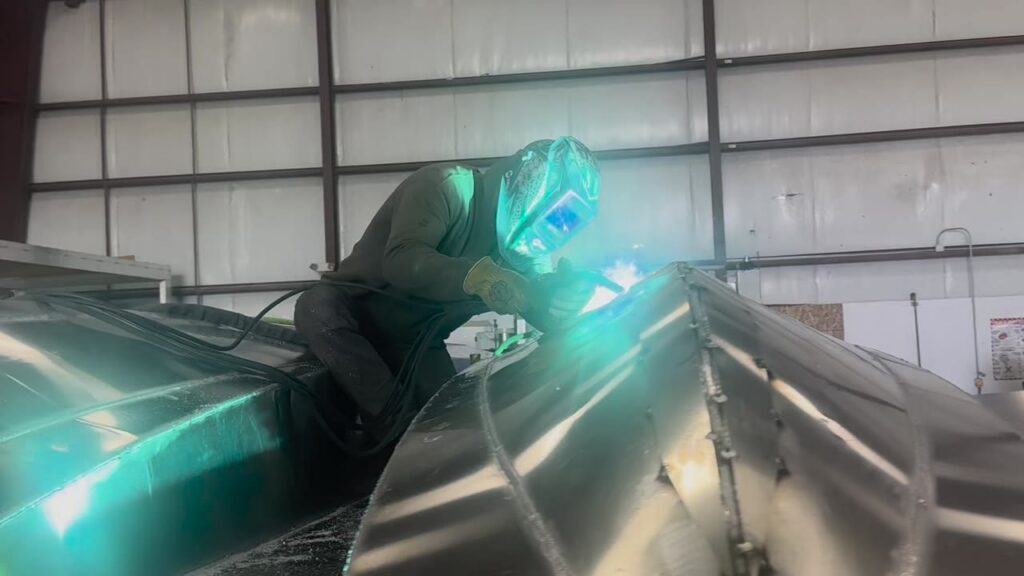
Built your wayEvery size, layout and power package on this page is a starting point. Length, beam, layout, power and outfitting can all change, and we work it out with you in 3D CAD before any plate is cut.
Start your custom buildRHIB questions
What does RHIB stand for?
Rigid hull inflatable boat. It's also called a RIB, for rigid inflatable boat.
What is a RHIB?
A rigid hull inflatable boat: a solid hull with an inflatable tube around the sides. The hull carries the load and sets the ride; the tube adds buoyancy, stability and a soft edge alongside.
Is a RIB the same as a RHIB?
Yes. RIB (rigid inflatable boat) and RHIB (rigid hull inflatable boat) are two names for the same type of boat.
What's the difference between a RHIB and an inflatable boat?
An inflatable boat's tubes are the boat, with a fabric or slatted floor. A RHIB has a solid deep-V hull with the tube around it, so it's faster in a chop, carries more and takes more abuse.
How long does a RHIB tube last?
It depends on the fabric, how much sun it sees and how it's cared for. Check the seams and valves and whether each chamber holds pressure, and plan on replacing a worn tube rather than patching it again and again.
What should I check on a used RHIB?
The tube (seams, valves, holding pressure), the hull at the keel and transom, the deck for soft spots, the engine hours and records, and the wiring. If the hull is good, the rest can be rebuilt.
Does a RHIB need its tube to float?
No. The rigid hull floats on its own. The tube is reserve buoyancy and stability, and it cushions the boat alongside.
What are RHIBs used for?
Boarding, patrol and enforcement, search and rescue, ship's tenders, offshore crew transfer, diving, research, training and recreation.
Why do militaries and police use RHIBs?
They're fast, stable in rough water, carry a full crew, and come alongside other vessels without damage, which is what boarding and rescue work demands.
What sizes do you build?
Our de Villiers RHIB designs run from 22′ to 39′: console, pilothouse and quick response boats.
Outboard or waterjet?
Outboards are simple to service and repower. A waterjet has nothing below the hull, runs the shallowest water and handles sharply alongside. Several designs come either way.
Who designs your RHIBs?
David de Villiers of De Villiers Marine Design in New Zealand. ARMOR Marine is the exclusive US builder of de Villiers designs.
Are your RHIBs built in the USA?
Yes, in our 16,000 sq ft shop in Anacortes, Washington.
What is a D-collar RHIB?
A boat with a D-shaped collar instead of a round tube. The flat back of the D mounts against a full-height hull side, so the deck runs out to the hull side and there's more deck inside the same beam. The collar can be air-filled or foam-filled.
Foam or air: which collar is better?
It depends on the job. Air is the lightest and softest and can be patched, but it has to be kept at pressure and a cut chamber goes soft. Foam can't deflate, but it's heavier and firmer. Our ARMOR hull collar puts closed-cell foam inside the welded hull, so there's nothing to puncture or inflate.
What collars do you build?
Round polyurethane tubes, inflatable and foam-filled D-collars, solid foam collars coated in polyurea, and the ARMOR hull collar on our Sentinels.
What is a polyurea-coated foam collar?
A solid collar of closed-cell foam, shaped to the hull and coated in tough polyurea. There's no air to lose and no skin to replace, so it keeps working after hard contact. It's the style used on the Coast Guard's first-generation Defender-class boats, and we use it on the Vigilance.
Can I get a RHIB-style boat without an inflatable tube?
Yes. Our Sentinel patrol boats use the ARMOR hull collar: the welded aluminum hull is shaped to form the collar and filled with closed-cell foam, so there's nothing to puncture or inflate.
Do you have RHIBs for sale?
We build to order: every RHIB is built for its owner, with the power and outfit for the job. Tell us about yours and we'll quote it. If you already have a used or surplus RHIB, we can rebuild it.
Do you build military RHIBs?
We build military-proven de Villiers RHIB designs to order, including boarding, ship's boat and special operations layouts, in our Anacortes shop.
Start your RHIB
We design every boat in-house, so we can build to your exact requirements and help you solve the technical problems a catalog boat can't.
Prefer to talk it through?
Related: de Villiers Series · Patrol & Ballistic · Sentinel Console 21 (ARMOR hull collar) · Sentinel Cabin 25 (ARMOR hull collar) · Aluminum Jet Boats and waterjet guide · Waterjet vs Outboard, Sterndrive and Propeller · USCG Defender-class RB-S / RB-HS refits · Aluminum Boat Repair · How We Build Custom