Who it's for
Sheriff's offices and police marine units working all year · Shallow-water patrol (jet version) · Search and rescue crews who need shelter
A cabin for long shifts
Patrol doesn't stop for weather. The Sentinel Cabin puts the crew inside, keeps the collar's protection outside, and lets you choose the drive that suits your water.
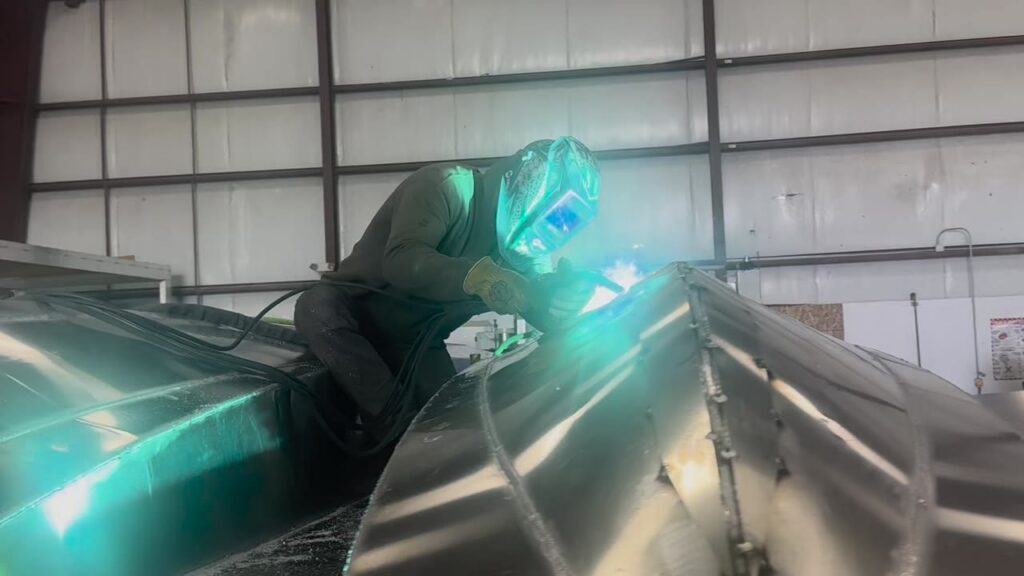
Most collars are fitted to a hull: inflatable tubes that can be cut or punctured, or sealed collars whose foam can take on water and have to be replaced. The ARMOR hull collar is part of the hull. Above the bottom, the welded aluminum hull sides step out and up to the gunwale to form the collar, and we fill it with closed-cell polyethylene foam, CNC hot-wire cut to the shape.
The foam takes on almost no water, so the boat doesn't get heavier as it ages, and the collar adds buoyancy high on the hull for a steadier boat at rest and reserve flotation that makes it virtually unsinkable. The design is protected by US Patents 10,336,414 and 10,780,958.
- 1The hull forms the collar. Above the bottom, the welded aluminum hull sides step out and up to the gunwale.
- 2Closed-cell polyethylene foam, CNC hot-wire cut to fit and set in from inside the boat. It takes on almost no water and doesn't swell.
- 3An inboard panel closes the collar. It comes off for access, and on a protected boat it's a ballistic panel.
- 4A deck lip inboard of the panel keeps deck water out of the foam and sends it aft.
- 5A panel retaining plate on the foam side holds the foot of the panel, with the deck lip on the inboard side.
- 6Open on the inboard side: no airtight seam to fail and nothing sealed in to trap water.
- 7The outer chine runs clear of the water on plane, so it adds no drag, and meets the water as the boat heels, so it pushes back.
- 8The bottom runs out under the collar: more planing area for the beam, with the deadrise set for the water you run.